When the Brand Is You: The Honest Truth About Living Inside Your Own Creative Business
Somewhere along the way, I stopped being a person who made things and became a thing that people consumed. I don't say that to be dramatic. I say it because it happened so gradually that I barely noticed until I was standing in my kitchen on a Sunday morning, instinctively composing a caption in my head before I'd even had coffee.
This is the part of the personal brand conversation that doesn't get talked about enough. We have endless content about how to build an audience, monetize your platform, and grow your reach. What we have very little of is honest conversation about what it costs — not financially, but personally — to turn your identity into a business.
So let's have that conversation.
The Moment the Job Follows You Home (Because It Never Left)
When your personal brand is you, there's no commute. There's no leaving work at the office. Every experience is potential content. Every vulnerability is a possible post. Every low moment is either something to share for relatability points or something to hide because it doesn't fit the narrative you've been building.
This is exhausting in a way that's hard to explain to people who haven't lived it. It's not the same as being a workaholic, though it can look that way from the outside. It's more like being an actor who never gets to take off the costume — except the costume is your actual face.
I've had days where I couldn't tell if I was genuinely happy or if I was performing happiness for an audience that had come to expect a certain version of me. That kind of blur is disorienting. And if you don't address it intentionally, it can quietly hollow you out.
The Pressure to Perform Consistency
One of the most underrated challenges of building a personal brand is the pressure to be consistently on. Your audience develops expectations. They came to you for a specific feeling, a specific energy, a specific kind of story. And there's a real tension between honoring that relationship and honoring your own internal weather.
I've gone through creative dry spells — periods where I had nothing interesting to say and zero desire to say it. In a traditional job, you're allowed to have off weeks. You show up, you do the work adequately, you wait for the spark to come back. When your audience is watching, that option feels like it disappears.
The solution I've slowly figured out isn't to fake enthusiasm — audiences can smell that from miles away, and it erodes trust faster than anything. It's to build enough of a content buffer and enough structural breathing room that you're never posting from a place of pure depletion. But more importantly, it's to be honest with your audience about the reality of creative cycles. The posts I've shared about creative blocks and uncertainty have consistently been some of my most resonant ones. People aren't following you because you're perfect. They're following you because you're real.
What Happens to the Art When the Art Becomes a Product
This is the question that keeps a lot of creators up at night, and rightfully so. There's a version of creative success that feels like a betrayal — where the thing you loved becomes a deliverable, where the joy of making gets buried under the pressure of metrics.
I've felt this. I've made things purely because I knew they'd perform well and felt nothing while making them. That emptiness is a warning signal, and it's one worth taking seriously.
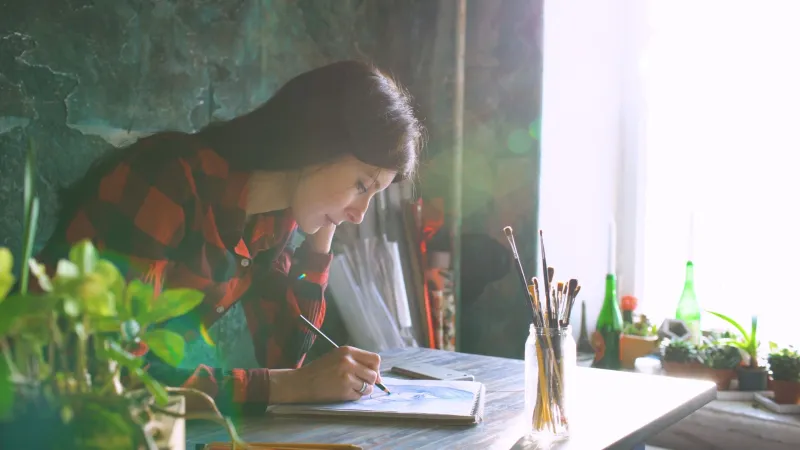
The creators I most admire — the ones who've been doing this for years and still seem genuinely lit up by their work — all seem to have some version of a protected creative practice. Something they make that isn't for the audience. A sketchbook that never gets posted. A journal that isn't a newsletter draft. A song that's just for them. That private space isn't a luxury. It's maintenance.
If everything you create is for consumption, you will eventually run out of things to say. You have to be a person first and a content creator second, or the content will eat the person.
The Business Side Nobody Prepares You For
Here's something that surprised me about turning my creative identity into a full-time business: I became, without really intending to, a small business owner. And small business ownership requires a set of skills that have nothing to do with creativity — accounting, contracts, client management, taxes, legal stuff, insurance.
In the US, this means figuring out quarterly estimated taxes, understanding what you can write off as a business expense, possibly forming an LLC, dealing with brand partnership contracts that have clauses you genuinely need a lawyer to review. None of this is glamorous. All of it is necessary.
The creators who struggle most financially are often the ones who are genuinely talented but treat the business side like an afterthought. Get a bookkeeper. Learn the basics of your own finances. Build a rate sheet. Understand the value of your own time. These things aren't at odds with being an artist — they're what allow you to keep being one.
Redefining Success When You're the Product
The metrics available to creators — follower counts, engagement rates, view numbers — are seductive and deeply misleading as measures of success. I've had posts with massive reach that meant nothing to me personally. I've had small, quiet pieces of work that generated emails from people saying it changed something for them. The second category is what actually keeps me going.
At some point, you have to decide what you're actually optimizing for. Reach? Revenue? Impact? Creative satisfaction? The honest answer is probably some combination of all four — but when they come into conflict, which they will, you need to know your hierarchy.
For me, creative integrity is the non-negotiable. Everything else gets built around that. That means I've turned down partnerships that didn't feel right. It means I've made things that underperformed by every measurable standard and would make them again. It means the business serves the work, not the other way around.
Living inside your own creative brand is strange, demanding, and — on the good days — one of the most fulfilling ways I can imagine spending a life. But it asks something real of you. It asks you to stay honest about who you are, separate from who your audience needs you to be. That gap, and how you navigate it, is everything.